
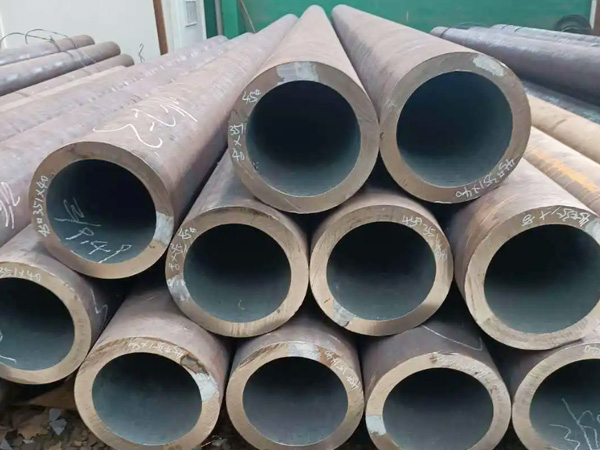
Seamless Steel Pipe
Seamless steel pipe is manufactured by piercing solid steel billets into hollow tube blanks through hot rolling, cold drawing, extrusion and other integral forming processes. There is no welded seam on the whole pipe body, which distinguishes it fundamentally from welded steel pipes such as straight seam and spiral welded pipes.
With integrated metal structure, uniform wall thickness, high pressure resistance, high temperature resistance and strong mechanical strength, seamless steel pipes have excellent tightness, impact resistance and corrosion resistance. Strict dimensional tolerance and smooth internal and external surface ensure stable performance under harsh working conditions.
Key Advantages
No Weld Joint
Overall one-piece forming, no welding defects, avoiding leakage and cracking risks.
**Superior Pressure & Temperature Resistance
Suitable for high-pressure, high-temperature and high-load working environments.
High Mechanical Performance
Good toughness, tensile strength and anti-fatigue property, adaptable to complex construction and industrial conditions.
High Dimensional Accuracy
Controlled outer diameter, wall thickness and roundness, easy for cutting, threading and deep processing.
Common Materials
Carbon steel: 20#, 45#, A106 Gr.B, A53 Gr.B, Q355B
Alloy steel: 4130, 4140, 15CrMo, 12Cr1MoV
Stainless steel: 304, 316L, 310S
Main Applications
Petroleum, natural gas and crude oil transmission pipelines
Power plant boiler tubes, high-pressure chemical pipelines
Hydraulic engineering, machinery manufacturing and automobile industry
Chemical, pharmaceutical and high-corrosion medium transportation
Pressure vessel, pipeline engineering and special industrial equipment
Short Marketing Version (for website & catalog)
Seamless steel pipe is produced by hot rolling, cold drawing or extrusion of solid steel billets without any welding seam. It features integral metal structure, high pressure resistance, high temperature resistance and outstanding mechanical stability. With reliable tightness and long service life, it is widely applied in petroleum, chemical industry, power generation, machinery manufacturing and high-pressure fluid transportation projects. Custom sizes and material grades are available to meet diverse industrial demands.
 Home
Home Product
 Contact