
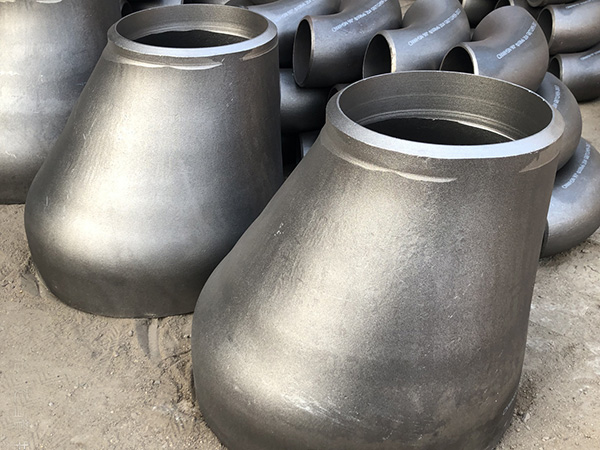
Eccentric Reducer
An eccentric reducer is a critical pipe fitting extensively applied in industrial piping systems,specifically designed to connect pipelines of disparate diameters with offset centerlines,distinguishing it fundamentally from concentric reducers.Structurally,it features one flat side and one tapered side,with the central axes of its two ends intentionally misaligned,creating an asymmetrical profile.This unique offset configuration ensures one side of the reducer remains parallel to the pipeline axis,forming a continuous flat surface either at the top or bottom.
Primarily manufactured via hot/cold pressing,forging,or combined reducing and expanding processes,eccentric reducers are commonly fabricated from carbon steel,stainless steel,and alloy steel,complying with rigorous standards like ANSI B16.9,GB/T 12459,and MSS SP 43.Their size range spans from 1/2"to 48"(DN15 to DN1200),covering pressure ratings from SCH 10 to SCH 160 to adapt to diverse industrial pressure conditions.
The core functional advantage lies in its ability to prevent fluid or gas accumulation—a common issue in horizontal pipelines.For liquid pipelines,it is installed with the flat side upward(FSU)to eliminate air pockets and avoid cavitation in pump suction lines.For gas pipelines,the flat side is positioned downward(FSD)to facilitate drainage of condensed liquids,preventing liquid buildup that could corrode pipes or disrupt flow.
Widely utilized in oil and gas,chemical processing,water treatment,and power generation industries,eccentric reducers are indispensable for pump suction pipelines,horizontal fluid transfer systems,and steam or gas lines.Unlike concentric reducers suited for vertical pipelines,their specialized design ensures stable flow,reduces turbulence,minimizes pressure loss,and maintains operational safety and efficiency by eliminating dead zones and blockage risks.
In summary,eccentric reducers are essential components for diameter transition in horizontal piping,with offset structure solving accumulation issues,reliable material and standard compliance ensuring durability,making them irreplaceable for stable and safe industrial fluid system operation.
 Home
Home Product
 Contact