
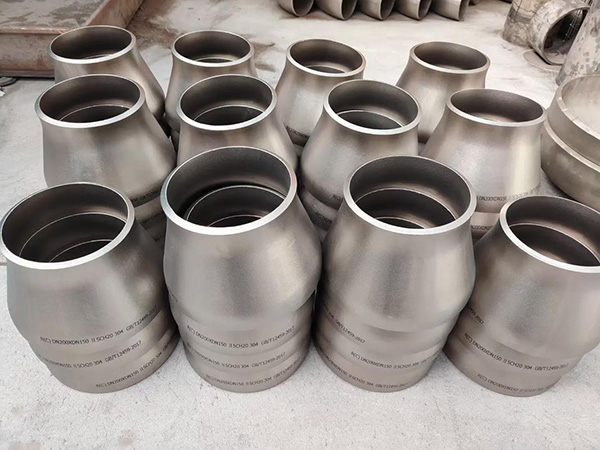
Concentric Reducer
A concentric reducer is one of the most fundamental and widely used pipe fittings in industrial pipeline systems.It is applied to connect two straight pipelines with different diameters,and its most prominent structural feature is the coaxial centerline of both ends.Unlike eccentric reducers with offset centers,the inlet and outlet circles of a concentric reducer share the same central axis,forming a symmetrical cone-shaped transition structure with uniform tapering on all sides.This regular and balanced shape ensures smooth overall contour of the pipeline after connection.
Concentric reducers are mainly produced through hot pressing,cold forming,forging and seamless integral forming processes.Common materials include carbon steel,stainless steel,alloy steel,and low-temperature steel.They strictly conform to international industrial standards such as ANSI B16.9,GB/T 12459,ASME,and MSS SP43.Available specifications cover a full range from small-diameter DN15 to large-size DN1200,with wall thickness classes from SCH10 to SCH160,capable of adapting to various high-pressure,high-temperature working conditions in heavy industry.
With excellent fluid transition performance,concentric reducers feature symmetrical internal flow channels that greatly reduce fluid turbulence and local pressure loss during medium transmission.The uniform structure avoids vortex areas,air pockets or liquid accumulation inside the fitting,keeping flow velocity stable and reducing wear on pipe walls.Due to their coaxial design,they are especially suitable for vertical pipelines,riser pipes and straight vertical flow systems.
They are extensively adopted in petroleum refining,chemical engineering,power plants,water supply and drainage,metallurgy,and general industrial piping projects.Compared with eccentric reducers,concentric reducers are more universal in layout installation and easier for pipeline alignment,welding and maintenance.With high structural strength,good corrosion resistance and long service life,concentric reducers serve as essential diameter-changing components to guarantee continuous,efficient and safe operation of overall pipeline systems.
 Home
Home Product
 Contact