
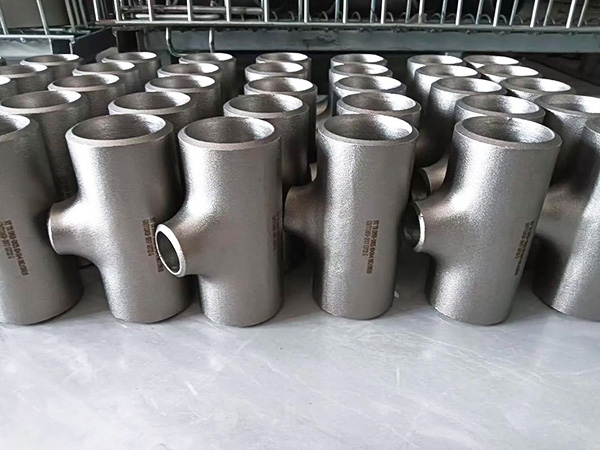
Reducing Tee
A reducing tee is a vital T-shaped pipe fitting widely used in piping systems to connect three pipes of different diameters,featuring two equal-sized ports for the main run and one smaller port for the branch line.Unlike equal tees with uniform port sizes,it is specifically designed to facilitate smooth size transitions,control flow rates,and eliminate the need for additional reducers or adapters,making it a versatile component in various industrial and civil applications.
Manufactured with strict adherence to international standards such as ASME/ANSI B16.9,MSS-SP-43,and GB/T12459,reducing tees ensure structural integrity and compatibility with diverse piping systems.They are available in a wide range of sizes,with main run diameters from 1/2″to 80″(DN15 to DN2000)and corresponding smaller branch sizes,while wall thicknesses follow schedules like SCH5,SCH40,STD,and XXS to meet different pressure requirements.
The choice of materials for reducing tees depends on the application environment.Common materials include carbon steel(ASTM A234 WPB),stainless steel(ASTM A403 WP304,316L),alloy steel,and nickel alloys,each offering distinct properties such as corrosion resistance,high-temperature tolerance,and strength for harsh industrial conditions.They are typically produced through seamless,welded,or forged processes to ensure durability and leak resistance.
Reducing tees play an irreplaceable role in numerous fields.They are extensively used in oil and gas transmission,petrochemical plants,water supply and treatment systems,HVAC systems,and agricultural irrigation,where they split main flow into smaller branch lines or combine flows while maintaining stable pressure and minimizing turbulence.Their compact design also saves installation space,simplifying pipeline layout and reducing maintenance costs.
In summary,the reducing tee is an essential fitting that enhances the flexibility and efficiency of piping systems.Its ability to connect different-sized pipes securely,withstand high pressure and temperature,and adapt to diverse environments makes it indispensable in modern industrial and civil infrastructure.
 Home
Home Product
 Contact