
The production and manufacturing process of large elbows
The production and manufacturing process of large elbows:
1. Material cutting
The plate thickness can be selected based on the wall thickness of the elbow, with a plate thickness t=2mm. According to the technical requirements of the elbow, the material is cut based on the allowable number of welds. For a standard 90-degree elbow, 3 to 4 welds are permissible, so the elbow can be cut into 3 to 4 segments. To ensure smoothness at the welds, each segment's edge (weld area) is cut along a planar development curve.
2. Rolling
After cutting, perform rolling bending with a curvature radius equal to half the diameter of the elbow. Each segment adopts single-curvature rolling bending, with a single-curvature radius (r) of 500mm. During rolling bending, use the straight edge as the reference to prevent tilting.
3. Weld the components into a closed ring shell
The rolled shell plates are welded segment by segment to form a closed loop shell. Nozzles for water injection and drainage are welded onto the closed loop shell. The water injection nozzle is used to fill the closed loop shell with liquid medium and apply internal pressure through a pressurization system (test pump), while the drainage nozzle is used for pressure relief and adjustment. Under the action of internal pressure, the shell undergoes plastic deformation and gradually approaches the desired shape
4. Ring shell bulging process
During the bulging process, an internal pressure load is applied to the ring shell according to the specified pressure curve. After each pressure increment, the pressure is held for a period before measuring the radial displacement data. The radial displacement in the experiment is obtained by measuring the relative displacement between each point and the reference point. When the pressure reaches 0.705 MPa, pressurization is stopped, and after holding the pressure for a certain period, the shape and dimensions of the ring shell approach the ideal state.
5. Cut segment
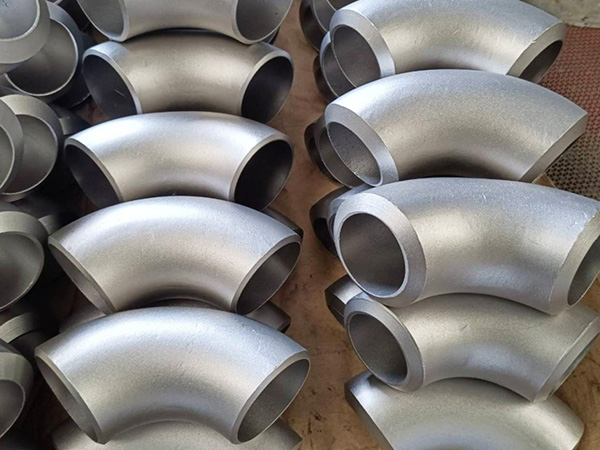
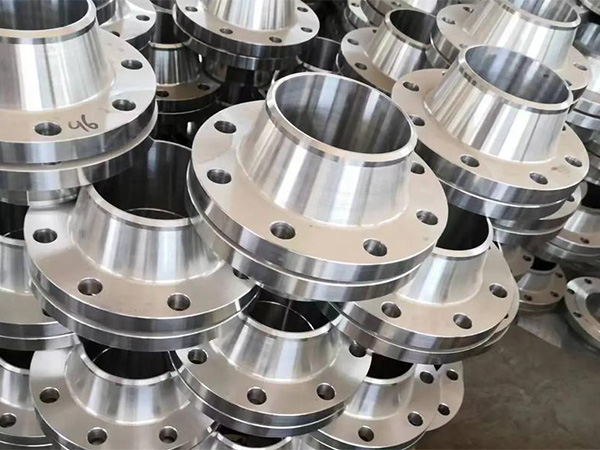
After the ring shell is pressure-formed, the weld seams are ground, and the elbow surface is smoothed. Then, the elbow is cut into segments according to the required bending angle, such as 30 degrees. 60. 75. 90. Wait, after segmentation, each section is connected to the corresponding flange, resulting in large stainless steel elbows with varying degrees of curvature.
6. Test Analysis of the Ring Bulging Experiment Results
For the ring shell in this experiment, the initial yield pressure (P) of the ring shell was calculated to be 523 MPa using the above formula, and the cracking pressure (P) was 1.44 MPa. The forming pressure in the experiment was 0.705 MPa, approximately 35% higher than the initial yield pressure. During the bulging process, as the internal pressure continuously increased, the radial displacement of the shell outward grew progressively, and the polyhedral ring shell gradually approached the shape of a circular ring. When the internal pressure reached 0.705 MPa, the dimensions of the circular ring were already close to the theoretical values. The post-bulging dimensions of the ring shell were obtained by measuring its external dimensions, specifically along the outer diameter and the axial cross-sectional diameter of the formed ring shell. The measured maximum and minimum diameters of the outer ring were 3006 mm and 2997 mm, respectively, while the measured maximum and minimum diameters of the cross-section were 1003 mm and 1000 mm. The measured data indicate that the polyhedral ring shell, after hydraulic bulging, essentially approximates a circular ring, with dimensions meeting the design requirements.
 Home
Home Product
 Contact